There are images that belong neither to memory no
projection, but to an intermediate state-a stable, almost
imperceptible mental temperature where reality settles
quietly. Stories at Room Temperature unfolds within this
space of latency: one in which narratives are not told, but
held in suspension.
Bringing together Munich-based artists Steffen Kern and
Jonah Gebka, the exhibition sets into tension two distinct yet
porous image regimes: on one side, drawing as the
condensation of interior, filtered, almost residual images; on
the other, painting as a framing device for the external
world.
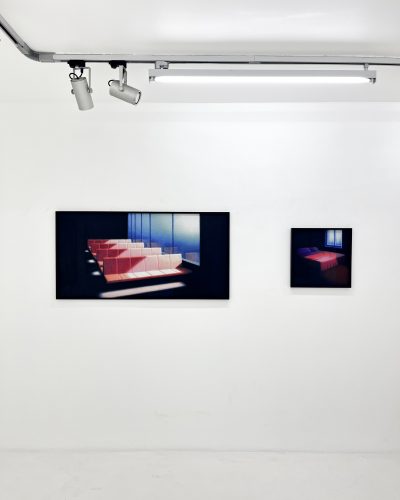
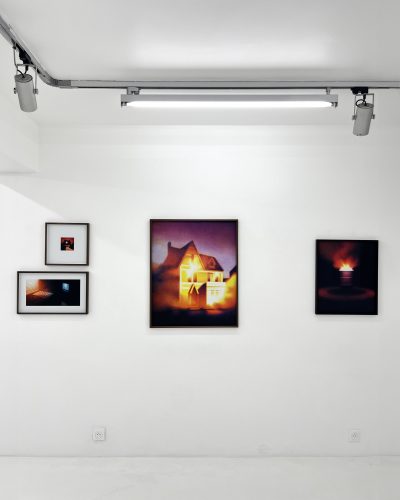
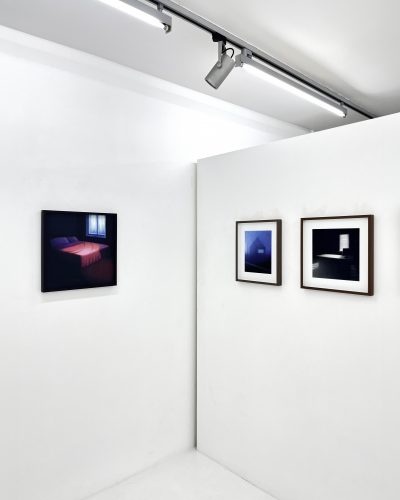
Steffen Kern develops a highly precise drawing practice
using colored pencils on paper, where the slowness of
execution contrasts with the intensity of the resulting
images. His scenes, anonymous interiors, deserted
architectures, isolated objects, or recurring motifs such as
fire-appear as fragments extracted from an interrupted
narrative flow. They evoke films that were never made, or
memories reduced to their remaining light.
Where the image is reduced to its minimal threshold, it does
not disappear; instead, it is held in suspension. Kern’s
drawings operate within an economy of narrative close to
cinematic ellipsis, or to the “empty scene” associated with
Antonioni. Fire, in particular, appears not as spectacle, but as
a contained presence-an image of suspended, nearly silent
energy.
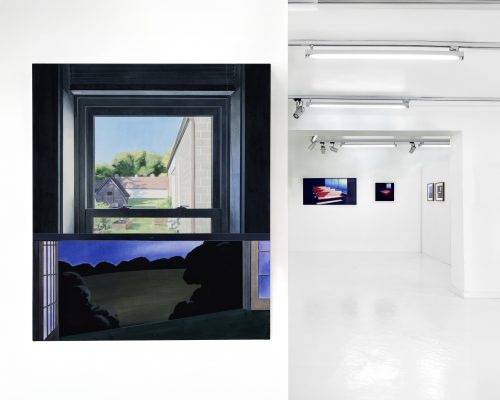
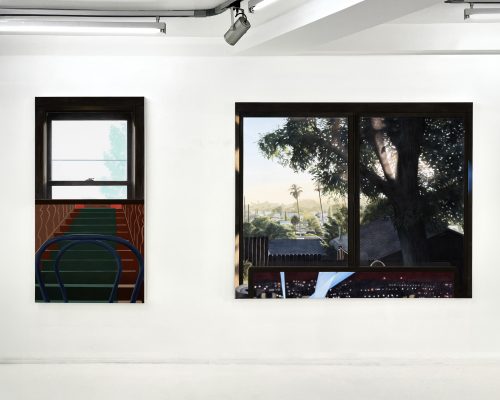
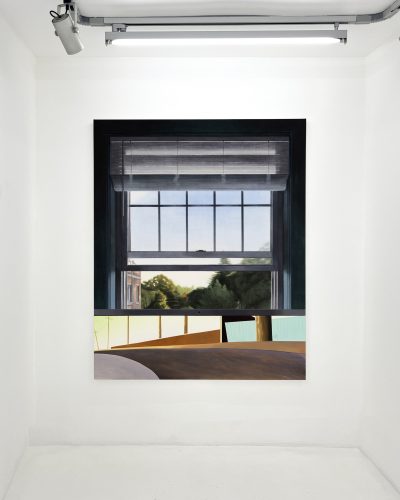
In counterpoint, Jonah Gebka’s paintings, executed in acrylic
and vinyl on canvas, construct layered spaces where interior
and exterior, memory and projection overlap. Windows,
frames, and intermediary surfaces play a structuring role,
emphasizing the mediated nature of vision. His scenes –
suburban landscapes, architectural settings, interiors-
oscillate between familiarity and dislocation, producing an
instability that resists any singular reading. Here, the image
functions less as representation than as an active
construction of perception.
In Gebka’s work, planes overlap, temporalities blur, and the
image unfolds through a logic of montage. Where Kern
operates through reduction, Gebka works through
proliferation; in both cases, the image escapes resolution.
The exhibition title, Stories at Room Temperature, serves as
a conceptual key: it does not propose storytelling, but the
conditions under which stories persist. At room temperature,
affects are neither intensified nor dissipated-they remain.
The images, too, occupy this intermediate state: neither fully
fixed nor fully narrative.
What connects the two artists, despite their distinct
practices, is an attention to the contemporary circulation of
images-between memory, fiction, and a saturated visual
environment. Both work from a diffuse visual culture in
which cinema, architecture, and everyday imageryrecombine
into quiet, self-contained surfaces.
The exhibition thus proposes a slowed mode of viewing,
almost meditative, in which each work functions as a
perceptual threshold. Not an accumulation of images, but a
sequence of visual situations to inhabit.
In a world defined by the speed and overheating of images,
Stories at Room Temperature opens a space in which
narratives settle, stabilize, and, paradoxically, become more
persistent.